The Chief Petty Officer Anchor Device: A History
From the first device before 1897 to the standard worn today — a century and a quarter of evolution in Navy Uniform Regulations.
The Chief Petty Officer hat anchor device is one of the most recognizable symbols in the United States Navy. Its specification history — recorded in successive Uniform Regulations and Bureau circulars — reflects the close institutional attention paid to the device that marks the Navy's backbone.
1893 — The Rate is Established
The rate of Chief Petty Officer was officially established on April 1, 1893, when all petty officer ratings and their pay were formally separated from lower enlisted ranks. Prior to the formal 1897 specification, Chiefs wore a cap device resembling a large version of a gold uniform button, bearing an eagle perched on an anchor's shank and surrounded by thirteen stars — similar in form to officer devices of the era.
1897 — First Formal Specification
CPO hat devices were first described in writing in the 1897 Navy Uniform Regulations:
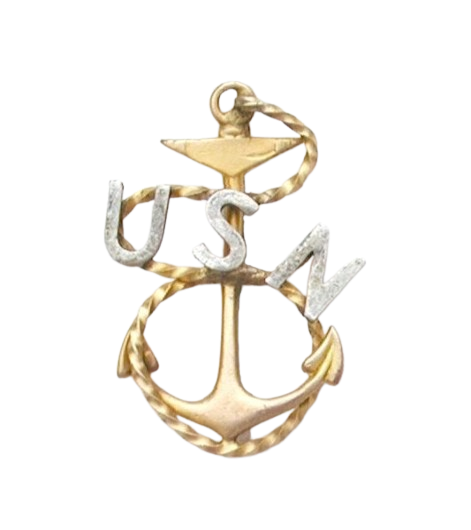
"The device shall be the letters U.S.N. in silver upon a gilt foul anchor."
This specification represented a deliberate distinction for the CPO rate — moving away from the eagle-and-anchor button design toward a device uniquely associated with the Chief Petty Officer.
1905 — Slight Inclination Specified
"The device shall be of metal, consisting of the letters U S N in silver upon a slightly inclined gilt foul anchor."
1922 — Precise Dimensions Required
The 1922 regulations provided the first exact measurements and construction requirements:
"Cap device shall be a brass foul anchor, gold plated, 1 5/8 inches in length overall and 1 inch across and outside of flukes. The letters U.S.N. to be of sterling silver 3/8 inch high and fastened about midway on the shank of the anchor. The cable to be made of twisted brass wire, gold plated. Devices to be fitted with a hinged pin and catch of brass and soldered to the back of the device."
1941 — Wire Replaced by Chain
The device changed again in 1941, recorded in the uniform specifications rather than the regulations. The most significant update: the twisted brass wire cable was replaced by chain — a change that persists in every device worn today.
1944 — Miniature Device Approved
Bureau of Naval Personnel Circular Letter No. 97-44 announced Secretarial approval of a miniature CPO cap device approximately three-fourths the size of the standard:
"Chief petty officers shall wear a miniature chief petty officer cap device on the left side of the cap, 2 inches from the front edge."
1947 — USN Letters in a Semi-Circle
The 1947 Uniform Regulations specified that the "U.S.N." letters were to be arranged in a horizontal arc on the anchor shank.
1951 — USN Letters in a Straight Line
The 1951 Navy Uniform Regulations changed the arrangement to a straight horizontal line, though the effective date was later clarified as 31 March 1944. The 1951 text:
"Shall consist of gold color metal foul anchor 1-3/4" long over-all, 5/8" wide at the stock, 1-1/8" wide at the flukes and other dimensions proportionate. Silver block letters 'USN,' each letter 7/16" high and 5/16" wide, shall be superimposed horizontally on the shank of the anchor, mid-way between the flukes and stock."
1954 — Both Styles Permitted During Transition
Permanent Naval Uniform Board Meeting No. 25, held on 26 January 1954, addressed the disposal of existing stocks of the older arc-style device. The Board concurred:
"The Board concurred with the recommendation of the Chief of Bureau of S & A to permit utilization of present stocks of chief petty officer cap devices with the 'USN' in a horizontal arc, in addition to the presently prescribed device, for reasons of economy and prevention of unnecessary waste. Future procurement of this item to conform to presently prescribed device."
1958 — Senior Chief and Master Chief Devices Established
On 1 November 1958, the Navy established two new senior enlisted grades: Senior Chief Petty Officer (E-8) and Master Chief Petty Officer (E-9). Their cap devices built directly on the existing CPO fouled anchor, with silver stars added to distinguish the grades:
- E-8 Senior Chief: the standard fouled anchor with one silver star
- E-9 Master Chief: the standard fouled anchor with two silver stars
The creation of these grades — and their distinct devices — recognized the growing technical complexity of the Navy and the need for senior enlisted leadership beyond the Chief Petty Officer level.
Post-1954 — Design Stabilizes
As old arc-style stocks were exhausted following the 1954 Board ruling, the straight-line USN specification became the sole standard. Since then, the fundamental design of the CPO cap device — gold-colored fouled anchor with superimposed silver USN letters in a straight horizontal line — has remained essentially unchanged for more than seventy years.
1999 — Garrison Cap Device Authorized for Outerwear
NAVADMIN 011/99 (January 1999) expanded authorized wear of the CPO device. The Chief of Naval Operations approved the garrison cap device (approximately 1-1/4 inch) for wear on outerwear — blue windbreakers, khaki windbreakers, black dress jackets, and all-weather coats. Optional wear began immediately; mandatory wear took effect 1 October 2000. This formalized a modern two-size standard:
- Large (1-3/4"): worn centered on the front of the combination cover
- Small (1-1/4"): worn on the garrison cap, 2 inches from the front edge
Today
The CPO cap device worn today traces an unbroken line back to the first formal specification of 1897. The gold-colored fouled anchor with silver "USN" letters — straight horizontal line, chain cable, 1-3/4" length — is worn by approximately 35,000 Chief Petty Officers serving in the United States Navy at any given time. The Senior Chief and Master Chief variants, with their added stars, carry the same heritage with the added weight of the Navy's most senior enlisted grades.
The device has outlasted wars, technological revolutions, and the complete transformation of what the Navy looks like — a constant mark of the Chiefs who keep it running.